Sialic acid sits on the surface of your cells, where it supports how they recognise and communicate with one another. Edible bird's nest is a natural source of it, and that is why it sits at the centre of ECHO.
190+ mg in a 70 mL bottle1
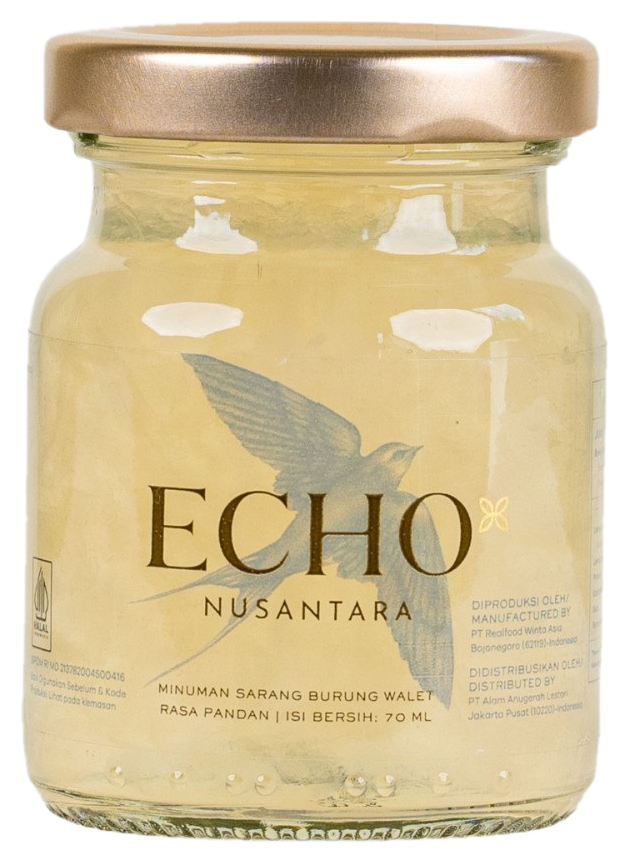
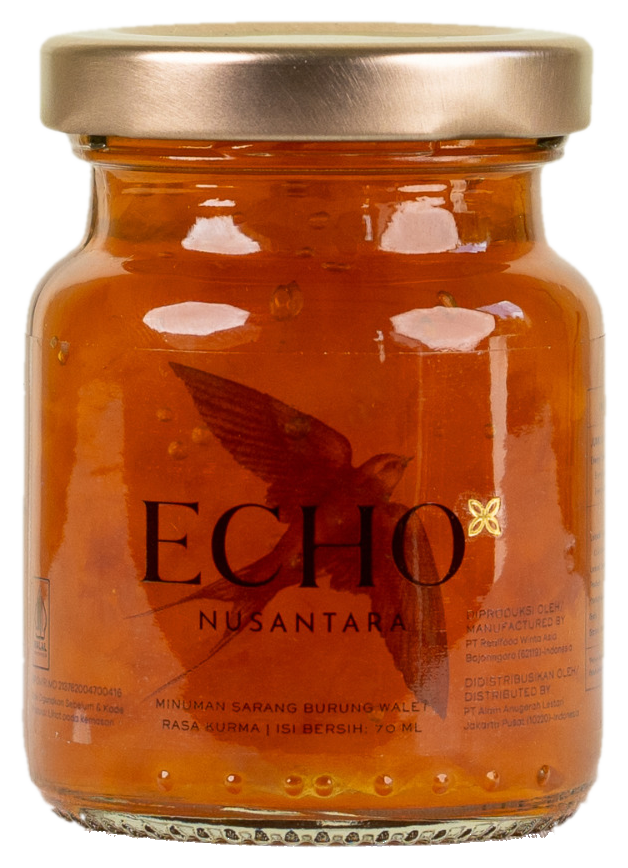
Dates and Pandan
Independent SGS lab
Pristine forest
ECHO Dates measured nearly twice the level reported for human colostrum.2
Based on published research and our SGS lab result.
Scroll to look closer.
Sialic acid is naturally found on cell surfaces, where it helps support cell communication, recognition, and the structure of the nervous system. It sits at the outer tips of the chains that cover each cell, the first point of contact when one cell meets another.
Described at the level of biological role. Not a claim that ECHO treats, cures or prevents any condition.
Part of the signals cells use to recognise and respond to one another.
Present in the structure of nerve cells and brain tissue.
Helps the body tell its own cells apart from what does not belong.
Edible bird's nest naturally contains sialic acid. ECHO nests come from pristine forests in Indonesia, and are made into a ready to drink bottle so the nest fits into an ordinary day.
We sent ECHO to SGS, an independent laboratory, to measure the sialic acid (NeuAc) in each variant. These are the results, as measured.
Tested by SGS on a production sample of each variant. Values are for a 70 mL bottle and rounded. Natural products vary slightly from batch to batch.
See the reports and certificatesIn an SGS lab test, ECHO Dates measured 3,086 mg/kg of sialic acid, nearly twice the level reported for human colostrum in published research.2
Bird's nest drink in 70 mL bottles, ready when you are.
Independent, peer reviewed research on sialic acid and edible bird's nest. Shared for general reading, not as a claim about ECHO.
We are here to help.
A natural compound found on the surface of cells, where it supports cell communication and recognition. Edible bird's nest is a natural food source of it.
Edible bird's nest naturally contains sialic acid, glycoproteins and amino acids. In an SGS lab test on a production sample, ECHO measured more than 190 mg of sialic acid in a 70 mL bottle.
No. SGS tested a production sample of each variant. We share the result as it was measured, and natural products vary slightly from batch to batch.
There is no fixed rule. Many people enjoy it in the morning or before bed, as part of a daily routine.
Yes. ECHO is a food product suitable for pregnant and breastfeeding mothers. If you have a specific health condition, please ask your doctor first.
Yes, for adults of all ages and for children above 4 years. ECHO is ready to drink and needs no preparation. For anyone with a specific health condition, please ask a doctor first.
ECHO is retort processed, which keeps it stable at room temperature. No preservatives or stabilisers are added.
Keep it at room temperature, away from direct sunlight. Once opened, enjoy it right away, or refrigerate and finish it soon.
Fine sediment is a natural part of bird's nest and is not a sign of damage.
No. ECHO is a food product. It is not intended to diagnose, treat, cure or prevent any disease.
1 SGS Vietnam lab test on a production sample, September 2025, converted to a 70 mL bottle and rounded.
Dates, report 0001083938: 3,086 mg/kg, about 216 mg in a 70 mL bottle.
Pandan, report 0001083931: 2,759 mg/kg, about 193 mg in a 70 mL bottle.
2 ECHO Dates contains about 1.85 times the sialic acid of human colostrum, by volume: 3,086 mg/kg (SGS) against about 1,671 mg/L on day 3 of lactation (Frontiers in Nutrition, 2022).
ECHO is a food product. It is not intended to diagnose, treat, cure or prevent any disease.
Before buying, check the packaging, label, BPOM registration and expiry date.